Useful things to know before your visit
Address: Natural History Museum, Cromwell Road, South Kensington SW7 5BD. Telephone: 0207 942 5000. Website: nhm.ac.uk
How much do the tickets cost?
The Natural History Museum is free, but temporary exhibitions might cost extra.
What are the opening hours?
Opening times are 10am to 5.50pm (Mon-Sun). Last entry is 20 minutes before closing time.
How much time do you need?
A typical visit to the Natural History Museum takes 3 hours.
Which buses go to the Natural History Museum?
Bus routes 14, 49, 70, 74, 345, 360, 414, 430 and C1 all stop close by. Here are the single bus fares.
Which is the closest train station?
The nearest station is South Kensington, which connects with the Circle District and Piccadilly lines. It only takes four minutes to walk to the Natural History Museum. Other stations within walking distance are Gloucester Road and Knightsbridge. Here are the London tube prices.
Which other attractions are nearby?
These attractions are all within 15 minutes walk of the Natural History Museum: Science Museum, Victoria & Albert Museum, Brompton Oratory, Royal Albert Hall and Albert Memorial.
 Twitter
 Facebook
 WhatsApp
 Email
My review of the Natural History Museum
If you grew up anywhere near London then this was one of the places that your parents took you to during the school holidays. They did a “fun day out at the museums” which involved catching a train to Waterloo and then a double-decker bus to South Kensington (because the tube was too scary for mums). Then you’d run around the Natural History Museum and the Science Museum for a few hours while they told you not to press all of the buttons.
Blue whale skeleton in the Hintze Hall
We came here loads of times because I was a big fan of dinosaurs, but obviously I’m a lot older now so I’ve totally grown out of dinosaurs (I like Star Wars instead) and here I am, thirty-five years later… still a kid… wondering what they’ve done with the giant Diplodocus in the entrance hall. Where’s Dippy gone? He was part of my youth! 150 million years he’d been standing there and they’ve replaced him with the bones of a big whale.
 Photo: londondrum.com
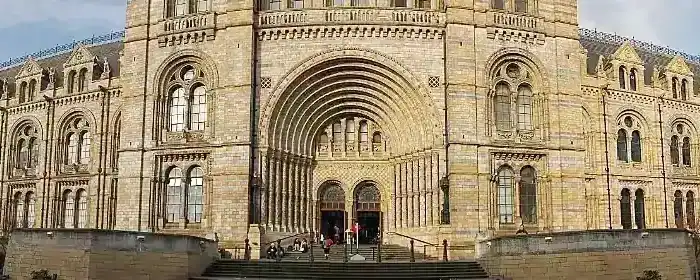
The first photo you’ll take will be of the beautiful room itself. You don’t appreciate the architecture when you’re a kid because you’re too busy looking at the pickled skins and skeletons but now I’m an adult I can happily stand here staring at the bricks and windows instead. The entrance hall looks like a cathedral without any pews. They don’t have statues of angels and saints in here, they have concrete creatures everywhere you look: climbing up the walls and across the tops of arches and wrapped around the banisters.
 Photo: londondrum.com
I’d normally start with the dinosaur rooms but they’re full of school kids at the moment and I’m not competing with that lot. That’s the problem with this place – too many children. They come in classroom battalions of thirty of more, all moving through the rooms like they’re on a forced march through the fens. So I’m starting with the creepy crawlies instead – kids hate creepy crawlies. You might want to skip this section if you’re scared of insects because it’s full of centipedes, millipedes, spiders and flies. They’ve got crickets the size of cricket bats, worms the size of snakes, wasps, hornets and a giant ant farm – the ants seem to be the only animals in the entire building that are still alive (although I imagine it would be quite difficult to stuff an ant).
Exoctic birds, dodos and a Victorian aviary
 Photo: londondrum.com
 Photo: londondrum.com
After that comes a corridor full of stuffed birds. One of the cabinets must have a hundred hummingbirds in it at least. Another one has an eagle, a six-foot emu, a couple of dead dodos and a feral pigeon. Normally the only time you see a dead pigeon in London is when it’s been squashed under the wheels of a double-decker bus, so it’s nice to see one all fluffed up and posing for photos.
Escalator in the Earth Hall
 Photo: londondrum.com
The Earth Hall is worth a visit simply to see the escalator tunnelling up through the centre of a pulsating proto-planet. It’s easily the best escalator in London (yes, I am that sad – I have a favourite escalator) – it’s like a Jules Verne ride up through a lava layer of hot rocks and bubbling magma, and upstairs is an exhibition of rocks and blocks of silica and stone.
As I enter the natural disasters zone I come across what looks like a full-scale evacuation in progress but it’s just another party of school kids in fluorescent yellow jackets, being marshalled around by a bearded teacher shouting loudly at Ben to behave himself.
Kobe earthquake simulator
They all pile into the Kobe earthquake simulator and start screaming as the floor shakes. In reality it’s just a few pots and pans banging about and a few bottles and boxes shuffling about on the supermarket shelves – it seems more like a windy day than an actual earthquake – but the kids have decided that they’re going to pretend to be absolutely petrified and start drowning out the sounds of destruction with their high-pitched screams. By the time I walk off I’m practically deaf, but I suppose they did make the experience a lot more realistic.
Collection of animals in the Dead Zoo
 Photo: londondrum.com
 Photo: londondrum.com
After that comes a room full of fish, squids and lobsters. They’ve got seahorses, seashells, starfish, crabs, corals and frogs. And then you head round the corner for one of the best rooms in London: the dead zoo. What they’ve done here is they’ve taken the entire population of London Zoo and killed them, stuffed them, and propped them up on pedestals. It would take me too long to list every animal on display so let me try and rhyme a few instead. They’ve got killer whales, blue whales, a kangaroo, caribou, brown bear, polar bear, bison, boars, hogs, dogs, yaks, bats, cats (lions, tigers and cheetahs), zebras, sloths, moths, a moose, goose, fox, ox, a goat, stoat, seals, eels, a giraffe, calf, a horse (of course), rhinoceros, hippopotamus, pelicans, elephants and a gazelle… but absolutely nothing rhymes with gazelle so I’m stopping there, but you get the idea anyway. It’s like the passenger manifest for Noah’s boat.
 Photo: londondrum.com
 Photo: londondrum.com
I’ve just realised something… the only animal that they haven’t got on display is a domestic dog. Imagine if they’d skinned a couple of Yorkshire Terriers and pinned them to the wall. That would be too much for some people. They don’t mind looking at dead dodos and dinosaurs, but staring at somebody’s pet dog would send them into a fit of fake outrage. In fact, if this museum didn’t already exist then it would be impossible to recreate because as soon as they killed their first animal they’d have three thousand RSPCA protesters marching past the front door.

Can you imagine if Charles Darwin had set out on HMS Beagle today? As soon as Greenpeace discovered that he had a load of captured animals on board they would have stormed his ship with speedboats and set them all free. Science would have been set back a century.
Fossils and skeletons in the Dinosaur Gallery
 Photo: londondrum.com
I suppose I’d better tackle those dinosaur rooms now. To say they’re packed with people would be a massive understatement – you get carried through the rooms like you’re trapped in a river, breaking on a bottleneck of bodies that forms around every corner. You’re surrounded by kids, huge schools of them, who suddenly stop like a flash mob so their teachers can count heads. Assuming you don’t mind negotiating all of that then they do have a few things worth seeing: they’ve got cabinets full of dagger-like talons and fossilised footprints, and the skeleton of a Triceratops, Iguanodon and Camarasaurus (plus another Stegosaurus in the Earth Hall).
 Photo: londondrum.com
 Photo: londondrum.com

Sometimes I have a hard time believing that these things really existed because they look like made-up movie monsters with weapons attached to their bodies: huge knives coming out of their thumbs and six-foot horns like swords on their heads. The Triceratops could probably have flipped over a Challenger tank. Imagine trying to catch your dinner in one million BC when it came with an inch of armour plating. It would have been hard enough trying to bring it down with a gun, but all they had was a sharpened stick!
Animatronic Tyrannosaurus Rex
 Photo: londondrum.com
When you round the final corner you’ll come face-to-face with a life-size Tyrannosaurus Rex who’s lunging around a swampy scene of green leaves and misty purple lights. Every now and then he twists his head round and lets out a few chainsaw roars, prompting all of the toddlers in their pushchairs to start wailing and flailing and begging their mums to pick them up.
I’m pretty sure that it’s an animatronic model but I’m not 100% certain, so I’m waiting around to see if he’ll rip the head off one of the annoying school kids. (They’ll probably fight back and stab him anyway – you know what kids are like these days.)
I’ve ranked the Natural History Museum as ★1 in my favourite London museums, ★6 in the best free attractions in London, ★9 in the best things to do with kids in London and ★18 in the 25 things to do in London at least once. It also appears in my one-day London itineraries with timings, one-day London itinerary for families, what to do in London in 2 days itinerary, spending two days in London with the family itinerary and how to spend a week in London itinerary
 London Squire guidebook – Check out my guidebook available to buy at Amazon, Apple and Kobo. I’ve personally visited 210 London landmarks, attractions and hotels and collected all of my reviews, example itineraries, handy practical info, and advice about using the buses and trains into an eBook, along with 675 original photos
Need some more ideas? Browse our London what’s on guide, London events today, events in London this weekend, London events in the next 7 days, what’s on in London in November and what’s on in South Kensington
What do you think? (4)
Ask a question, or share your experience of the Natural History Museum
Leon Hello. My son is dinosaur mad and he wants to go. Do you know what skeletons they have got of the dinosaurs? (reply)
Craig Hi Leon. The only complete skeletons I saw were a Stegosaurus, triceratops, iguanodon and Camarasaurus, and they’ve got a life-size animatronic model of a T Rex as well, and some smaller Velociraptor robots. But they’ve got loads of other dinosaur fossils like a Scolosaurus and Baryonyx. (reply)
BB Do they still have that tunnel to the museum? Where is it and how do you get there because it’s been a long time since I’ve been. (reply)
Craig Hi BB. There’s a tunnel leading from South Kensington tube station to the corner of the museum. When you come through the ticket barriers you’ll see the entrance on the righthand side (it’s still within the station). (reply)
Leave a comment (no need to register)
Forum - Landmarks, Attractions & Events