Useful things to know before your visit
Address: Banqueting House, Whitehall, Westminster SW1A 2ER. Telephone: 0333 320 6000. Website: hrp.org
How much do the tickets cost?
You can buy adults tickets from £11, seniors (aged over-65) from £8, young adults (aged 16-17) from £5. Children (0-15) are free.
What are the opening hours?
Opening times are 10am to 4pm (Mon and Thu-Sun, Aug to Sep). Last entry is 1 hour before closing time.
How much time do you need?
A typical visit to Banqueting House takes 45 to 60 minutes.
Which buses go to Banqueting House?
Bus routes 3, 11, 12, 24, 53, 87, 88 and 159 all stop close by.
Which is the closest train station?
The nearest station is Westminster, which connects with the Circle District and Jubilee lines. You can walk the ¼ mile to Banqueting House in about 4 minutes.
Which other attractions are nearby?
These attractions are all within 15 minutes walk of Banqueting House: Downing Street, Household Cavalry Museum, Horse Guards, Churchill War Rooms, Big Ben, Benjamin Franklin House, London Eye, Nelson’s Column, Trafalgar Square, London Dungeon, St. James’s Park, Houses of Parliament, SEA LIFE London Aquarium, Westminster Abbey and National Gallery.
 Twitter
 Facebook
 WhatsApp
 Email
My review of Banqueting House
For its first 300 years Whitehall Palace (or York Place, as it was then called) was the London residence of the Archbishops of York – most famously from 1514 to 1529 when it was home to Henry VIII’s Lord Chancellor, Thomas Wolsey. The royal Palace of Westminster had burned down in 1512 so when Wolsey fell out of favour Henry grabbed it for himself.
The architect Inigo Jones
Elizabeth I added its first banqueting house but James I was never very happy with it so he commissioned the country’s finest architect to build a better one in 1619.
 Photo: londondrum.com
Inigo Jones had studied the work of Andrea Palladio during his Italian travels and was using this Palladian style at Queen’s House (which you can go and see in Greenwich). If you’re wondering why that building is so heralded then you have to remember what London looked like in the 1620s – most of it was still single storey wood or made of skinny Tudor bricks and then along came the shining white stone of Renaissance Rome with its perfect proportions, perspectives and neo-classical columns.
Inside Banqueting House
The first thing they do when you step inside the front door is point you down a darkened corridor underneath the main room where you can learn a little of the building’s history. There’s not a lot down there though, just a few pictures of Charles I and Inigo Jones, a couple of info boards, floor tiles and broken bits of pottery, and a wooden map of Whitehall to show you the layout.
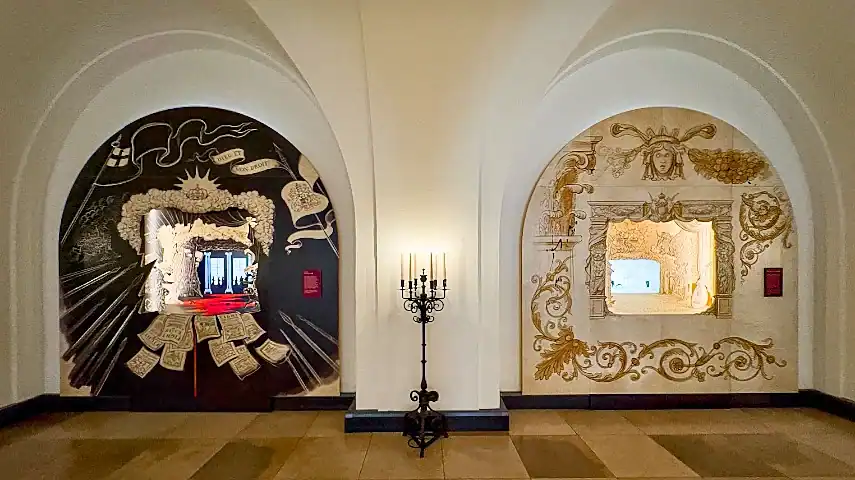 Photo: londondrum.com
It all seems a bit light considering the pivotal history that happened here, but then they send you up a staircase and through the double doors and everything is forgiven. I’m not normally bowled over when I see a famous painting but the Rubens on the roof is something else. And I say that as a middle-aged bloke with no particular interest in art.
The ceiling painting by Peter Paul Rubens
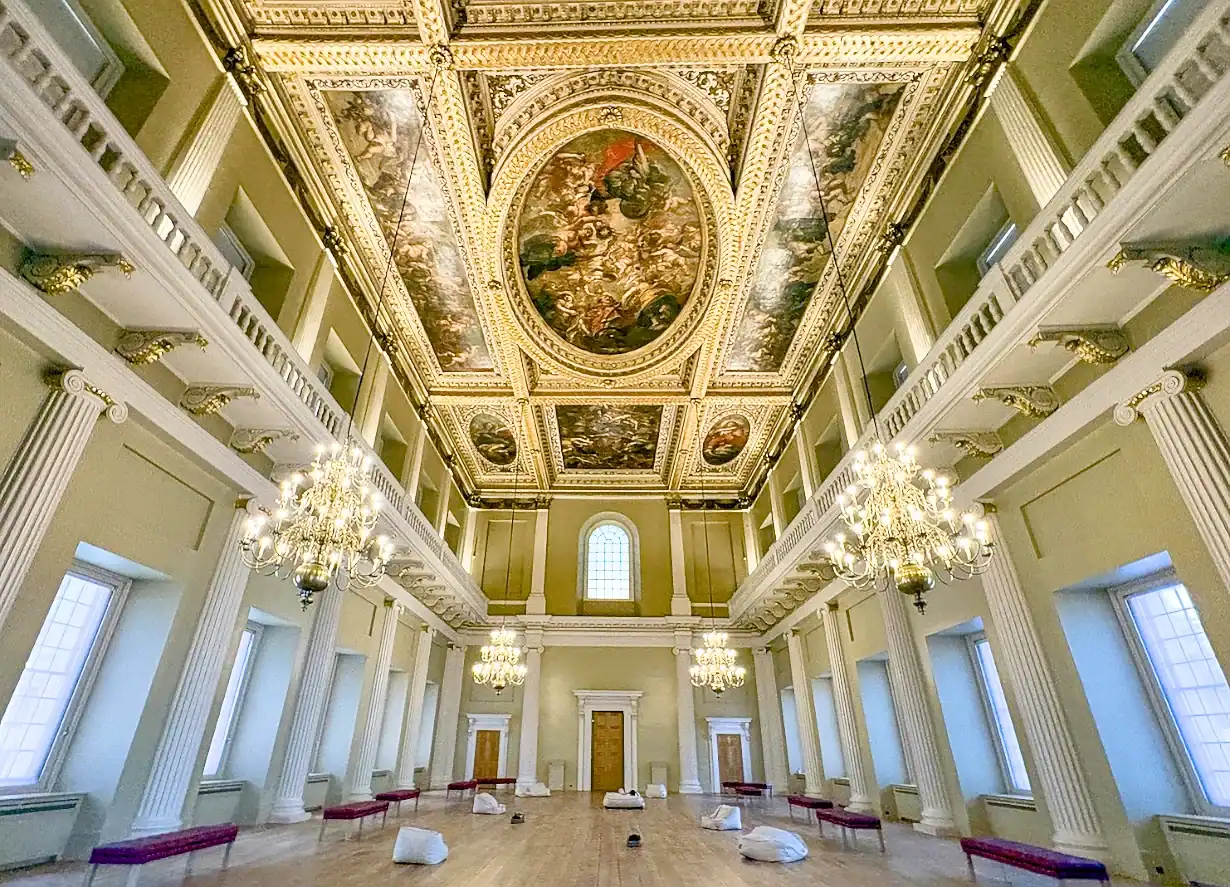 Photo: londondrum.com
As you pause at the door it will be towering two storeys above your head with four hanging chandeliers underneath, making the gilded frames glow with a golden light.
Charles I commissioned it to glorify his father’s achievements and hopefully shine a bit of reflected light on himself. The central section shows him being carried up to heaven while the ones on either side depict him as a wise and peaceful ruler, uniting the crowns of England and Scotland.
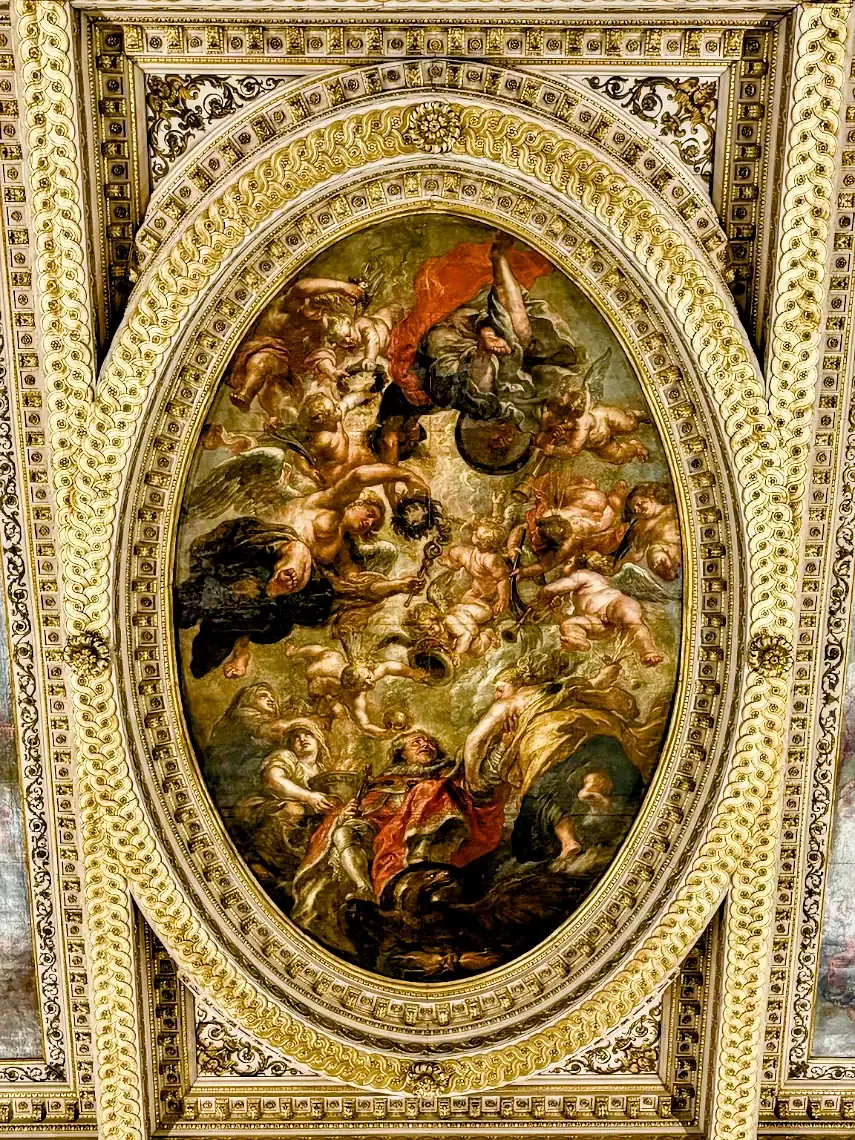 Photo: londondrum.com
During the day the hall would have been used for royal receptions, ceremonies and greeting foreign dignitaries, but during the evening it was transformed into a candlelit setting for masques – an extravagant form of entertainment that combined music, singing and theatre with a crowd of courtiers dancing about in half-masks.
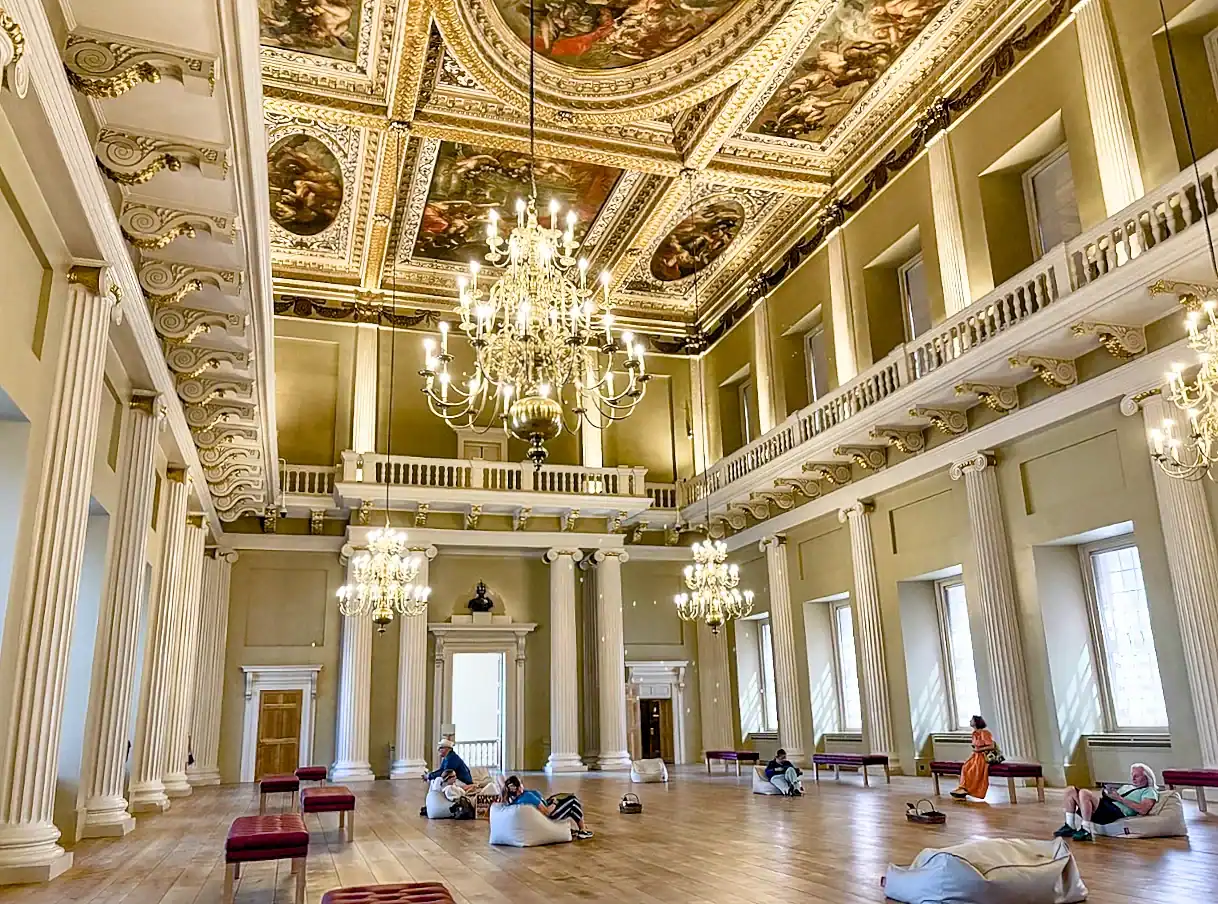 Photo: londondrum.com

Apart from the painting the room is otherwise empty, with just a few benches, beanbags and handheld mirrors so you can study the ceiling without straining your neck.
I should say something about the commentary because in the past they always used to provide you with an audioguide so you could sit and listen to the stories on a headset, but we’re living in the future now so you’re expected to point your own phone at a QR code by the door. This takes you to a website to read. Unfortunately the video links take you straight to YouTube (who wants to pay an entry fee to watch YouTube videos on your phone?) and all of the audio files longer than a snippet are hosted on Spotify. If you’re okay downloading Spotify’s app then it’s easy enough to follow the instructions and install it, but I don’t think the trendy young designers who come up with these brilliant wheezes appreciate quite how difficult the older generation finds it. (My mother wouldn’t even get past the QR code!) I’m sure a lot of people don’t even attempt it.
King Charles I’s execution in 1649
Charles I might have intended the paintings to cement his own divine right to rule but after nine years of bloody fighting in the English Civil War he was condemned to death as a tyrant.
He spent his final night in St. James’s Palace (just over the road through the park) before being led on a military march through Horse Guards into Banqueting House. He then looked up at the paintings for one final time before stepping through a window onto a specially-built scaffold in the street. (The actual window no longer exists, but it was roughly above where the visitors’ entrance is today.) If you look across the road to the clock tower then you can see a little smudge behind the exact time he died.

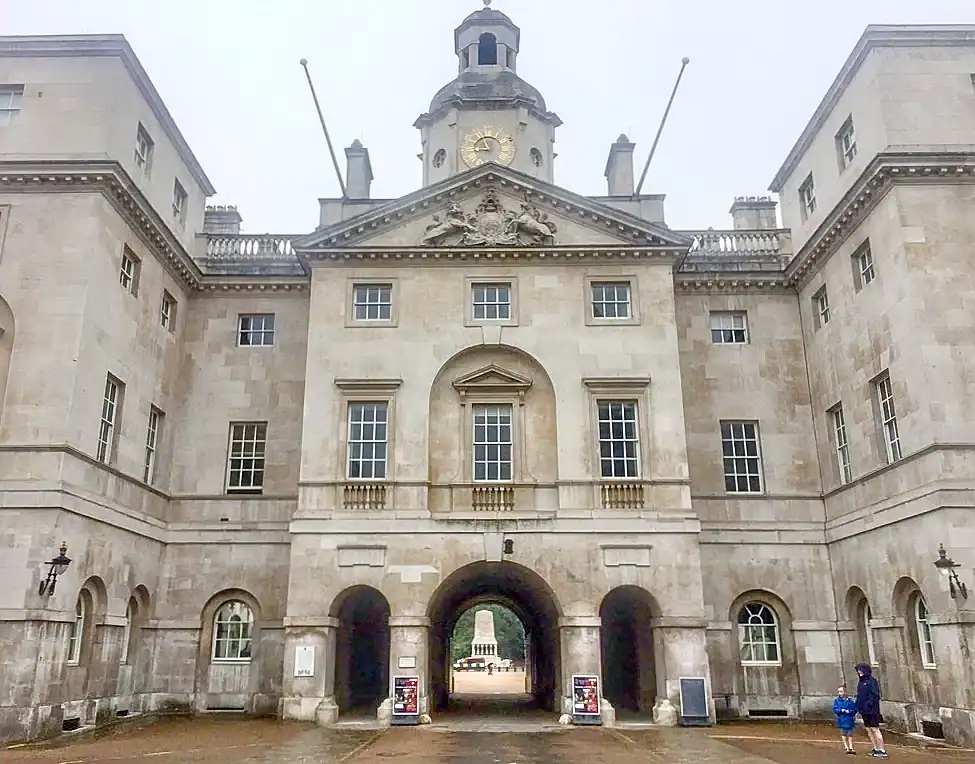 Photo: londondrum.com
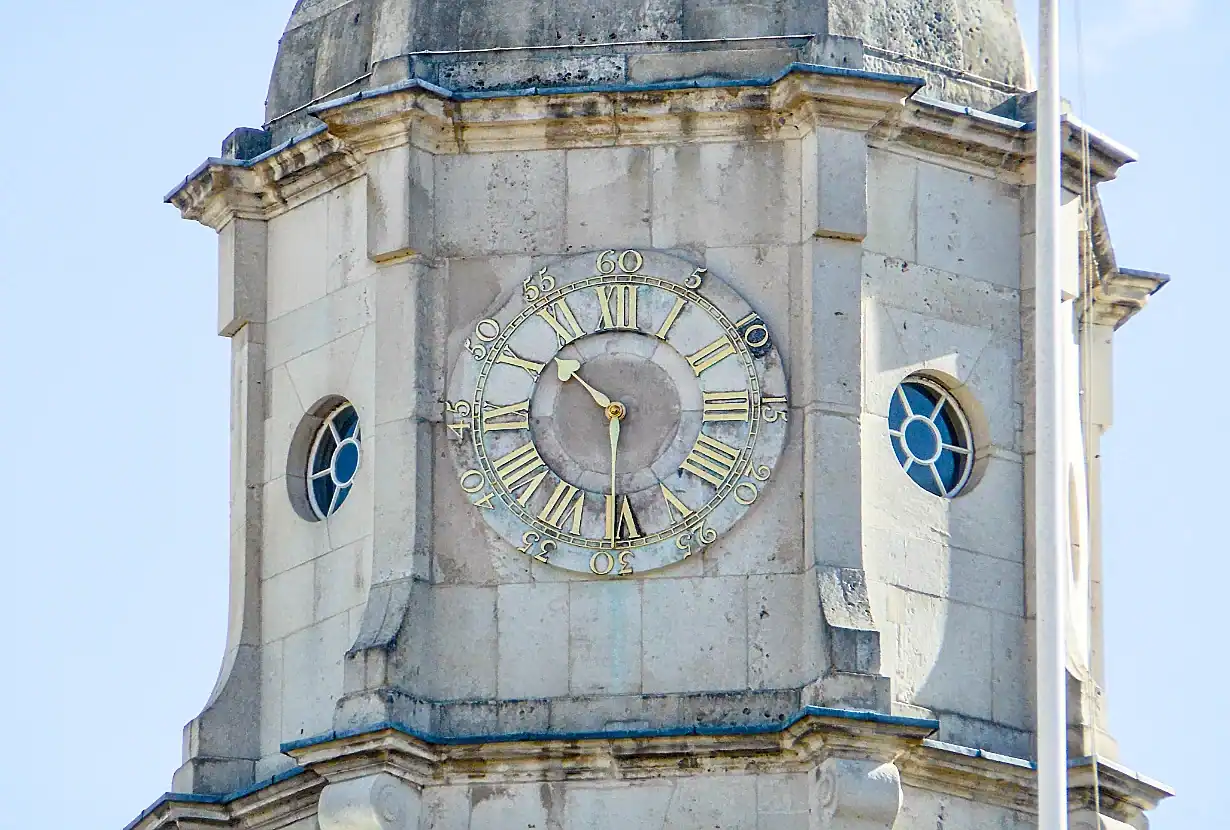 Photo: londondrum.com
Whitehall Palace fire in 1698
Whitehall Palace continued as the home of English kings and queens for another fifty years until the whole place burned to the ground after they left a brazier blazing in a bedchamber.
William III managed to save the paintings by bricking up the windows, but the only other building left untouched by the flames was the Holbein Gate opposite. (This was demolished in 1759 to make way for the traffic.) Christopher Wren and Nicholas Hawksmoor were tentatively asked to design a new palace but William III never cared for the area and nothing came of it. He spent the rest of days in Kensington Palace and Hampton Court.

In summary then… the Rubens is every bit as good as it promises to be, but bear in mind that you’re coming to see the ceiling and that’s it. If you add on the display cases downstairs (10-15 minutes) and scroll through the website (20-25 minutes) then that’s all there is. A tip: if you want to listen to those Spotify files on your phone then you might want to bring your earbuds.
I’ve ranked Banqueting House as ★6 in my favourite historical sites in London
It also appears in my two days in London itinerary
You can see some more Rubens paintings at the National Gallery, including Samson And Delilah, The Judgement Of Paris and Le Chapeau de Paille. The Courtauld Gallery at Somerset House has Landscape by Moonlight, and you can see The Rainbow Landscape at the free Wallace Collection. You can visit Charles I’s tomb in St. George’s Chapel at Windsor Castle

 London Squire guidebook – Check out my guidebook available to buy at Amazon, Apple and Kobo. I’ve personally visited 210 London landmarks, attractions and hotels and collected all of my reviews, example itineraries, handy practical info, and advice about using the buses and trains into an eBook, along with 675 original photos


What do you think? (6)
Average rating ★★★★★★★★★★Ask a question, or share your experience of Banqueting House
JoannaP A hidden masterpiece which is every bit as breathtaking as I was led to believe. I came here specifically to see the painting but I didn’t realise that a king was put to death here, and it gave extra meaning to the painting to think that it was the last thing he saw as he stepped out onto the gallows. Truly wonderful. (reply)
Carol A great vid, I love your posts forthright and honest, keep up the good work Regards, Carole Waterer. (reply)
↳Craig Thanks Carol, I’m glad you liked it. (reply)
Glyn We are trying to pack as much as we can into one day in London and we will already be seeing Big Ben, Horse Guards Parade and Downing Street in the area, and I would like to know whether you would recommend squeezing in a visit to Banqueting House as well, seeing as we are already in the area? (reply)
↳Craig Hi Glyn. I do usually recommend a visit, but not if you’ve only got one day because there are better things to do in the area like Westminster Abbey, the National Gallery in Trafalgar Square, or maybe a walk up to Buckingham Palace. There’s only really one thing to see at Banqueting House – the painting. If you really want to see a Rubens then I’d prefer the National Gallery. (reply)
JohnT I re-visited Banqueting House after its recent refurbishment and I am glad to report that the painting is still as stunning as ever 👍. I did however struggle with the new way they present the information, but after talking to one of their helpful guides we did eventually get it working. (reply)
Leave a comment (no need to register)
Forum - Landmarks, Attractions & Events